Federal Government Reverses Course,Now Sees Benefit of PSA Testing...
NCI Admits its Previous Prostate Cancer Study was ‘Contaminated’ Following the Release of New Data that Shows PSA Test Saves Lives
The nation’s leading authority on cancer has thrown out its own study on prostate cancer screening, now saying that PSA testing reduces the prostate cancer death rate by nearly 50 percent.
In its July 13th bulletin, the National Cancer Institute says findings from the Göteborg Randomized Population-Based Prostate Cancer Screening Trial - a study NCI partially funded in Sweden - shows “PSA screening substantially improves cancer-specific survival without the extent of over-diagnosisand overtreatment.” The Swedish study showed testing reduces the prostate cancer mortality rate by 44 percent. That prompted NCI to admit there was a “significant amount of contamination” in its earlier Prostate, Lung, Colorectal, and Ovarian study (PLCO), which suggested there was no mortality benefit with the PSA test.“Careless mistakes like this may be costing men their lives. You can’t publish that there is no value in getting tested if you don’t have the right data to back that claim up,” said Skip Lockwood, ZERO’s CEO.
“Admitting you were wrong is the first step - the American Cancer Society has yet to swallow its pride and come clean – so now NCI needs to take action to make things right,” said Lockwood.
In the bulletin, NCI says the PLCO data was contaminated because of “men in the trial who had already undergone screening with a PSA test, which a number of researchers have said may preclude the trial from ever demonstrating a cancer-specific survival improvement.” Regarding its new data from the Swedish study, NCI goes on to quote Dr. Eric Klein of the Glickman Urological and Kidney Institute who says the “data suggesting that a baseline PSA in men in their 40s and subsequent PSA velocity (the rate of increase in PSA levels) can predict both lifetime risk of developing cancer and potentially lethal cancers.”
Tuesday, July 20, 2010


Saturday, July 17, 2010
Why are Sick Old Men so Damn Funny?
…at least they THINK they are
Of course I’ve always considered myself wittier than the average geezer (my wife says half-witty) but recently I’ve noticed that most of the old guys I talk to who have prostate cancer are always laughing and joking. They seem to share a set of common characteristics:
- They are very knowledgeable about their condition and know what treatments have been tried, which worked (a little), and what their prognosis is so there are no surprises or illusions
- They are willing and able to discuss prostate cancer intelligently with anybody and don’t get into ‘poor me’ scenarios
- They are mostly cool, calm, and good natured
- And they have an underplayed, wicked, irreverent, dark sense of humor – particularly regarding their incurable condition. Jokes about incontinence and impotence abound (not much else can be done about these conditions at this point). Side effects, such as enlarged breasts, also make for witty, if not politically correct, repartee.
Is this the result of denial or senility? Possibly. Should we all be more serious? Maybe, but I don’t think so. Laughter is good medicine; even when it comes from bad jokes and unpunny puns. And we need all the good medicine we can get.
There will be plenty of time to worry and be serious later. There is NO evidence that being sane and serious lengthens life. So for now, let the pun times roll!
axman
Sunday, July 4, 2010
You Sure Don’t Look Terminal
Prostate cancer doesn’t make you look very sick…
Whenever I go to one of my doctor’s offices (a disgustingly common occurrence) there will be people in the waiting room in wheel chairs, on crutches, holding oxygen tanks, coughing, bandaged from head to foot, or just sitting with a totally vacant stare. But I (prostate cancer and all) don’t show even the slightest symptom (unless you count gray hair and wrinkles)! I seem out of place around all those sick people.
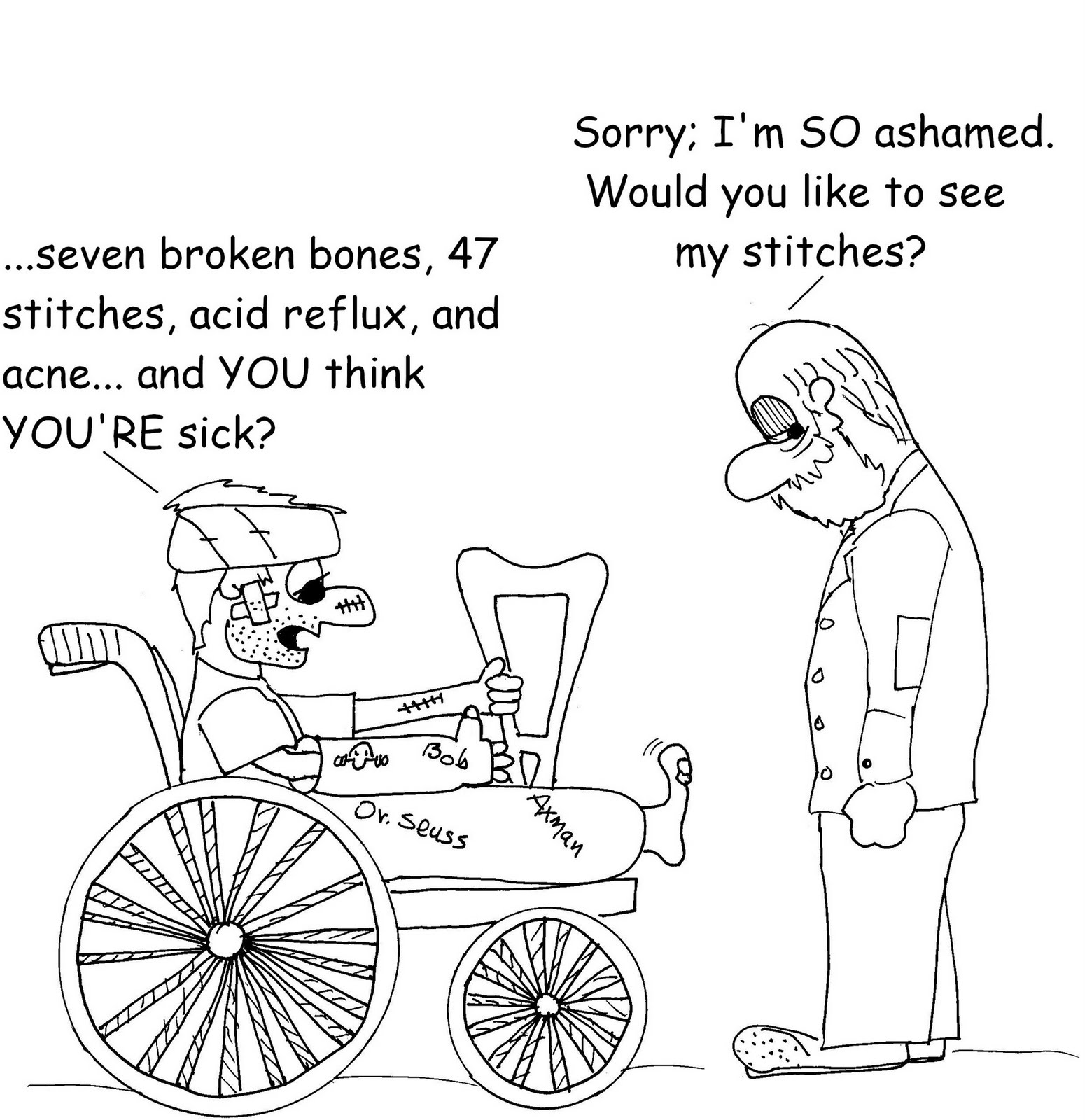
When I’m around friends or in classes or even meeting people at social events and the conversation comes around to cancer (it always seems to among the old folks in my social circle) I answer their questions about my cancer. Then there’s always the, “Now way,” “Can’t be,” “You don’t look sick,” and “Are you sure” statements. Maybe if I was pale or limped or drooled (more)… I DO have a scar but don’t usually offer to display it in polite company or during casual conversations.
Most cancers, of course, don’t have a lot of visible symptoms – and in fact that’s not really so bad at all. Believe me, I’m happy with my invisible symptoms and hope I never get to the point when I’m obviously sick – even if it means not getting a lot of heartfelt sympathy.
axman
Wednesday, June 23, 2010
The Advantages of NOT having a Prostate
Look on the bright side, old timer...
I’ve bemoaned all this and more. But what about the upside? Upside? There’s an upside?
 Here is a list of some, if not all, of the obvious and not so obvious benefits I have observed and experienced from no longer having a prostate to kick around.
1. Most important to me - I’m alive seven years later and still counting
2. I never hold up lines in public restrooms (believe me, this can be a godsend)
3. I lost the two ounces the prostate weighed but I hardly notice the weight loss
4. I have an awesome scar to show anyone brave enough to want to see it (so far no one has ever asked to see it)
5. I’m definitely sterile – as if it matters to anyone as old as me
6. I can tell humorous and entertaining stories at parties about tubes and bags and diapers (my wife says definitely NO to this possibility)
7. Once the deed was done, it was done; no specific ongoing treatment – nobody ever gets a prostate implant – not yet anyway…
I consider my prostatectomy one of the more significant events of my life – after marriage, parenthood, grandparenthood, and running a few marathons.
axman
Sunday, June 13, 2010
Prostate Cancer has gone to the Dogs
Maybe they’ll take a bite out of cancer...
We all know that dogs can track the lost and detect drugs at airports and border crossings. Now they have been trained to detect prostate cancer by identifying a specific scent in male urine (which, I’m told, is NOT in the male at the time of diagnosis). This has nothing to do with the dogs in your life that have been unrepentant crotch sniffers.
There are a number of articles and blogs explaining the research and telling you everything except just what exactly it is the dogs are detecting. Here are two links that pretty much sum up the French study.
Sniffing Out Cancer or Study Finds Dogs Can Detect Prostate Cancer will give you more details or maybe just wagging tails.
I’ll bet you really want to know if you’ll encounter a dog the next time you visit your oncologist. Probably not, but stranger things have happened. The dogs in the study were 95% accurate – much better than the reported 85% accuracy of the tried and true PSA. Maybe some combination of blood samples and urine sniffing will turn out to be 99% accurate!
The value of this study is probably in the fact that there is something that can be detected in urine and clever scientists will probably find another, less canine, way to detect it. Sorry Rover, sit, stay, good boy.
For most of us who already have prostate cancer this potential breakthrough won’t do much, but it just might help our sons and grandsons. We’ll see.
axman
We all know that dogs can track the lost and detect drugs at airports and border crossings. Now they have been trained to detect prostate cancer by identifying a specific scent in male urine (which, I’m told, is NOT in the male at the time of diagnosis). This has nothing to do with the dogs in your life that have been unrepentant crotch sniffers.

There are a number of articles and blogs explaining the research and telling you everything except just what exactly it is the dogs are detecting. Here are two links that pretty much sum up the French study.
Sniffing Out Cancer or Study Finds Dogs Can Detect Prostate Cancer will give you more details or maybe just wagging tails.
I’ll bet you really want to know if you’ll encounter a dog the next time you visit your oncologist. Probably not, but stranger things have happened. The dogs in the study were 95% accurate – much better than the reported 85% accuracy of the tried and true PSA. Maybe some combination of blood samples and urine sniffing will turn out to be 99% accurate!
The value of this study is probably in the fact that there is something that can be detected in urine and clever scientists will probably find another, less canine, way to detect it. Sorry Rover, sit, stay, good boy.
For most of us who already have prostate cancer this potential breakthrough won’t do much, but it just might help our sons and grandsons. We’ll see.
axman
Wednesday, June 2, 2010
Run, Rest, Recover, Repeat - - - Eventually
It takes a long, long time…
My motives (like me) are more or less pure and simple; I just want to get in shape to run another (ONE more) marathon. How hard could it be? I’ve done it 75 times before. But the dark powers of the universe seem to be conspiring against me (like in a Greek tragedy).
I’m not talking about serious injuries, hurricanes, floods, or even fire. I’m talking about the frailty of my own body and how long it takes to recover from a workout.
I’ve been doing this for six decades or so and have noticed a diabolical trend. In the early days it was pretty easy; I could do two workouts a day with no downside. Then it was one-a-day workouts until my late 40s. For the next 20 years or so I could muster every-other-day training. But now it takes three or four days between even moderate workouts to make sure the kinks are gone, the muscles are no longer sore, and the fatigue has moderated. Not fair.
A little more sleep, longer sessions in the hot tub, and a nap now and then all seem to help. But, time’s a wasting! Where did those ‘runner’s highs’ and ‘endorphins’ go? Maybe there is an age limit. I’ll let you know what I find out.
axman
My motives (like me) are more or less pure and simple; I just want to get in shape to run another (ONE more) marathon. How hard could it be? I’ve done it 75 times before. But the dark powers of the universe seem to be conspiring against me (like in a Greek tragedy).

I’m not talking about serious injuries, hurricanes, floods, or even fire. I’m talking about the frailty of my own body and how long it takes to recover from a workout.
I’ve been doing this for six decades or so and have noticed a diabolical trend. In the early days it was pretty easy; I could do two workouts a day with no downside. Then it was one-a-day workouts until my late 40s. For the next 20 years or so I could muster every-other-day training. But now it takes three or four days between even moderate workouts to make sure the kinks are gone, the muscles are no longer sore, and the fatigue has moderated. Not fair.
A little more sleep, longer sessions in the hot tub, and a nap now and then all seem to help. But, time’s a wasting! Where did those ‘runner’s highs’ and ‘endorphins’ go? Maybe there is an age limit. I’ll let you know what I find out.
axman
Sunday, May 23, 2010
Us Old Men with Prostate Cancer are actually Living Longer
If you ask ten doctors why their PC patients are living longer you’ll probably get ten different answers. You’ll get the same variety of responses from those of us who have the dreaded PC. We all have an opinion but facts are few.
Is it:
- New medications and treatments?
- Better diets?
- Exercise for the elderly?
- Positive attitudes?
- All of the above?
- Some of the above?
- None of the above?
I don’t know for sure if I’m living longer than expected – certainly not longer than I expected. But then I’m a cockeyed optimist – mostly.
Long ago I decided NOT to take it easy and “go gently into that good night” (apologies to Dylan Thomas). I have never seen any evidence that being active and pushing your limits does any harm. And even if it does, it keeps life from being boring.
Life is always terminal so having a terminal disease doesn’t change things all that much – hopefully.
axman
Wednesday, May 12, 2010
It’s Just like Herding Cats
When I use the term ‘prostate cancer clinical trial’ you probably immediately have visions of old men taking exotic pills, getting strange injections, donating copious quantities of blood and other fluids, having full body X-rays, and tolerating invasive body probes.
 Not so - this one is different.
A group of men with incurable prostate cancer and their wives (who do NOT have prostate cancer) were invited to participate in a six month twice weekly closely monitored strength training class. Including my wife and me, there are 20 in each class and husbands and wives work as a team (what an original concept) doing a series of simple but challenging strength building and stretching exercises. The plan is to get stronger, fitter, and ultimately live longer - maybe even save marriages.
The idea of husband and wife working together (a long shot at best) is supposed to increase the possibility of continuing the exercises when the program is completed.
Of course getting 20 old duffers to do anything as a group and stay focused isn’t easy and the instructors/experimenters have their hands full. It’s a lot like, well, herding cats.
axman
Sunday, May 2, 2010
Ask Lots and Lots of Questions
…just don’t expect lots of answers
I see several doctors every two or three months. I give blood, get weighed (and keep gaining), have my blood pressure checked, and am told that nothing has changed. It’s all pretty mundane and boring.
But, I usually have a list of questions to ask – at least a few. I believe it is my job to ask questions – it’s MY life. My doctors likely (at least in their minds) roll their eyes and say, “Oh no, not again.”
Is there anything new in meds or clinical trials?
What’s next when THIS med stops working?
Is it OK if I decide to run a marathon (fantasy thinking)?
What could I be doing that makes the bad cells grow faster?
How am I going to pay for all this?
Do I get answers? Sometimes. Sometimes the doctors ask me what I think. They may or may not listen to my answers.
If I can get them to think about what I’m thinking it just might lead to something in the future (my future).
My lifelong training and education has been to accept that doctors should know the answers and we patients should obediently and quietly listen and obey. Nope.
A friend of mine (who incidentally died of cancer) always said his preferred way to die was to be shot by a jealous husband. I’d prefer to be done in by global warming or even a charging elephant. I’m not sure just what choices I may have at the time.
In the meantime I plan to survive indefinitely and keep asking questions (my doctors may eventually decide on their own way to do me in).
axman
I see several doctors every two or three months. I give blood, get weighed (and keep gaining), have my blood pressure checked, and am told that nothing has changed. It’s all pretty mundane and boring.

But, I usually have a list of questions to ask – at least a few. I believe it is my job to ask questions – it’s MY life. My doctors likely (at least in their minds) roll their eyes and say, “Oh no, not again.”
Is there anything new in meds or clinical trials?
What’s next when THIS med stops working?
Is it OK if I decide to run a marathon (fantasy thinking)?
What could I be doing that makes the bad cells grow faster?
How am I going to pay for all this?
Do I get answers? Sometimes. Sometimes the doctors ask me what I think. They may or may not listen to my answers.
If I can get them to think about what I’m thinking it just might lead to something in the future (my future).
My lifelong training and education has been to accept that doctors should know the answers and we patients should obediently and quietly listen and obey. Nope.
A friend of mine (who incidentally died of cancer) always said his preferred way to die was to be shot by a jealous husband. I’d prefer to be done in by global warming or even a charging elephant. I’m not sure just what choices I may have at the time.
In the meantime I plan to survive indefinitely and keep asking questions (my doctors may eventually decide on their own way to do me in).
axman
Friday, April 23, 2010
On the Road Again…
Whether it’s around the block or around the country, it’s good to be on the go. Really.

I have been in a seven-year prostate cancer holding pattern – a series of treatments, no cures, just doing what needs to be done to keep progression as slow as possible. That’s as good as it’s going to get far as I can tell. But I have also noticed that when I’m at home for any extended period of time – particularly in the wet
So, we do a lot of running around (traveling makes us sound too sophisticated). We visit friends around town, spend time with kids and grandkids in other states, go to lots of historical spots, and do more than our share of camping and hiking in the summers. We even get out of the country once in a while. Our kids gave up any hope of an inheritance years ago.
When I’m doing things – especially new and interesting things, I feel better and go days at a time without ever thinking about my health problems – less time to dwell on self pity. It works for me.
axman
Subscribe to:
Posts (Atom)
